
Self-Hosted Email Marketing in 2026: A Complete Guide to Infrastructure, Deliverability, and Automation
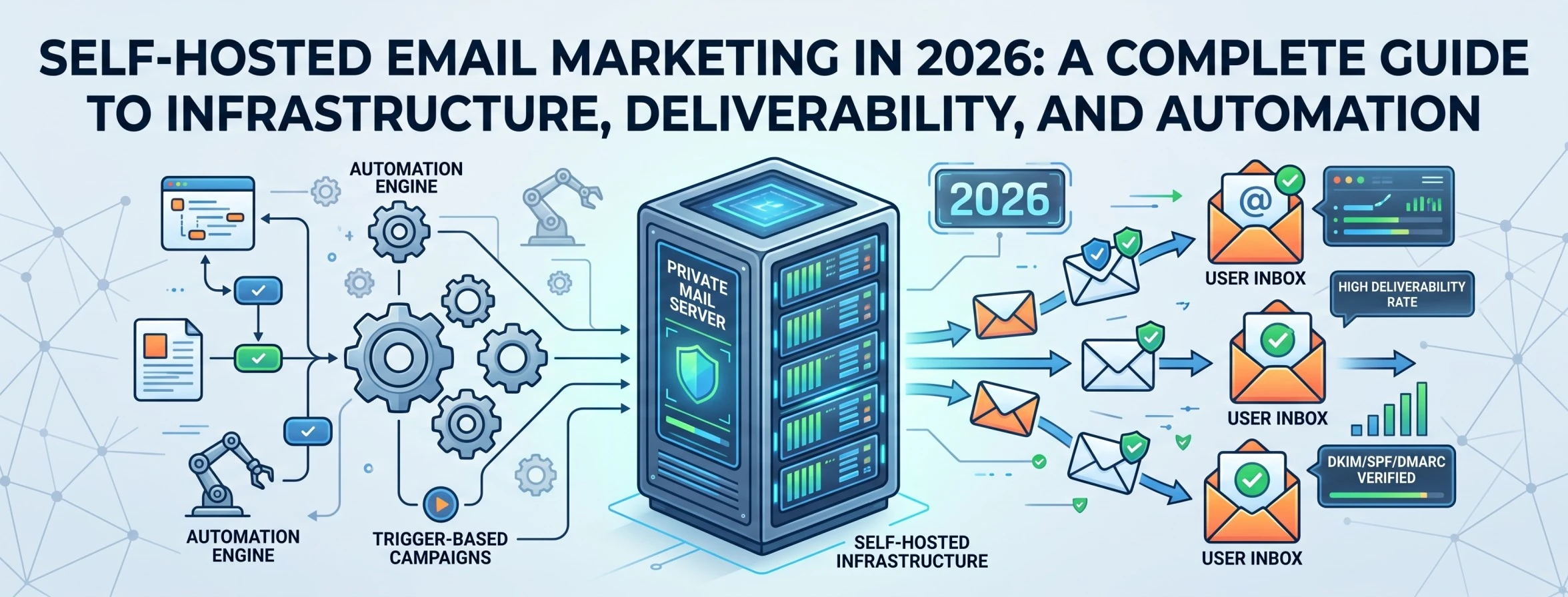
In 2026, self-hosted email marketing refers to deploying and managing your own email marketing software and sending infrastructure rather than relying entirely on a third-party cloud service. As data privacy regulations tighten and the desire for full control over digital assets grows, many businesses are moving away from traditional managed providers to build custom, private email marketing systems.
It is important to differentiate between the two core components of this ecosystem: hosting the email marketing application (the interface where you design emails and manage contacts) and hosting the email delivery infrastructure (the servers that actually transmit the messages over the internet).
Platforms like Relayzo serve as the self-hosted email marketing software, giving you the interface and automation engine while allowing you to plug into your preferred sending infrastructure. However, it is vital to set realistic expectations: while self-hosting provides ultimate control and data ownership, successful email delivery still depends heavily on proper technical configuration, rigorous authentication, and maintaining a stellar sender reputation.
What Is Self-Hosted Email Marketing?
At its core, self-hosted email marketing means you install, host, and maintain the email marketing application on your own servers (such as a VPS or dedicated server) rather than renting access to a web-based SaaS platform.
In a traditional SaaS email marketing platform, the provider manages the application, the database, and the sending infrastructure (SMTP servers) as a bundled package. In a self-managed email marketing setup, these layers are decoupled:
- The Application: The software where marketers build campaigns and workflows.
- The Database: Where subscriber data and analytics are securely stored.
- The SMTP Server/MTA: The infrastructure that dispatches the outgoing messages.
This separation offers a massive advantage in data ownership in email marketing. Because the database lives on your servers, subscriber data never passes through a third-party SaaS provider’s hands, making compliance with strict privacy frameworks much easier to manage. It also unlocks deep customization, allowing developers to integrate the email infrastructure directly with internal CRMs or proprietary databases.
How Does Self-Hosted Email Marketing Work?
To understand how a private email marketing system operates, it helps to look at the complete flow of an email campaign from creation to the recipient’s inbox.
Email Marketing Application
The journey begins in the application layer. This is where you handle campaign creation, leveraging drag-and-drop builders or HTML editors. It is also where contact management, segmentation, and automation workflows are defined. When a campaign is scheduled, the application pulls the relevant segment from the database and prepares the individual messages.
SMTP or Mail Transfer Agent
Once the application prepares the emails, it passes them to a Mail Transfer Agent (MTA) or SMTP Server via an API or SMTP relay. The MTA is the engine of your email delivery infrastructure. It sorts the messages, manages sending queues, attempts deliveries, and processes bounce codes if a recipient’s server rejects the message.
DNS and Domain Authentication
As the SMTP server dispatches the email, it relies on your Domain Name System (DNS) records to prove its identity. Through standards like SPF, DKIM, and DMARC, your domain effectively vouches for the sending server, ensuring that receiving mailboxes recognize the email as legitimate rather than a spoofed phishing attempt.
Receiving Mail Servers
Finally, the message arrives at receiving providers like Gmail, Outlook, or Yahoo. These providers evaluate the incoming message by checking your domain authentication, assessing your IP and domain reputation, and filtering the content for spam triggers before deciding whether to place the email in the inbox, the spam folder, or reject it entirely.
Why Businesses Are Considering Self-Hosted Email Marketing in 2026?
The shift toward self-hosted solutions in 2026 is driven by several strategic business requirements:
- Greater Infrastructure Control: Businesses want the ability to tune their sending speeds, manage their own IP addresses, and control their MTA configurations.
- Data Ownership and Privacy: Keeping subscriber data in-house simplifies compliance with global data protection regulations.
- Customization and Integration Flexibility: A custom email marketing software environment can be deeply integrated into bespoke internal tools without API rate limits.
- Predictable Infrastructure Costs: High-volume senders often find that scaling email marketing capacity on their own infrastructure provides a flatter, more predictable cost curve compared to tiered SaaS pricing.
- Reduced Dependency: Decoupling the application from the sending infrastructure means you are not locked into a single SaaS provider’s ecosystem.
It is crucial to note that self-hosting is not automatically cheaper or “better” for everyone. The true email marketing ROI and total cost of ownership depend heavily on your existing server infrastructure, the cost of maintenance, delivery services, and the technical resources you have available to manage the system.
Essential Infrastructure for a Self-Hosted Email Marketing System
Before launching campaigns, a robust self-hosted architecture requires several distinct components working in harmony.
VPS or Dedicated Server
Your software needs a home. A VPS email server or a dedicated server provides the necessary compute resources, memory, and bandwidth. Reliability and scalability at this level dictate how responsive your application is during massive campaign sends.
Email Marketing Application
This is the campaign management platform, such as Relayzo, which provides the user interface for marketers to design emails, manage lists, and review analytics without needing to touch the command line.
SMTP or MTA
The SMTP infrastructure handles the heavy lifting of dispatching emails. Whether you configure your own MTA (like Postfix or PowerMTA) or connect your self-hosted application to a specialized third-party SMTP relay (like Amazon SES or SendGrid), this component is non-negotiable.
Domain and DNS Configuration
Proper email server configuration requires access to your DNS settings to establish sender identity and authentication records.
Database and Storage
A reliable database management system (like MySQL or PostgreSQL) is required to securely store subscriber information, engagement metrics, and campaign assets. Regular automated backups are essential here to prevent catastrophic data loss.
Email Deliverability in 2026: What You Need to Know
Self-hosting gives you the keys to the car, but it does not guarantee you will reach your destination. Inbox placement remains the ultimate challenge, and self-hosting does not automatically bypass spam filters.
Successful email deliverability optimization requires managing several moving parts:
- Sender Reputation: A holistic score assigned to your brand by mailbox providers based on your sending habits.
- Domain and IP Reputation: Mailboxes track the historical trustworthiness of both your sending IP address and your root domain.
- Authentication: Unauthenticated mail is almost universally blocked in 2026.
- Bounce Management: Repeatedly sending emails to invalid addresses will rapidly destroy your reputation.
- Spam Complaints: High complaint rates (users clicking “Mark as Spam”) are the fastest way to get your domain blocklisted.
- List Quality & Engagement: Sending to unengaged subscribers signals to providers that your mail is unwanted.
- Sending Consistency: Erratic volume spikes look like spamming behavior; consistency builds trust.
SPF, DKIM, and DMARC for Self-Hosted Email Marketing
In 2026, email authentication is not optional. Mailbox providers strictly enforce DNS email records to protect users from phishing.
What Is SPF?
The SPF record (Sender Policy Framework) is a DNS record that lists the IP addresses explicitly authorized to send emails on behalf of your domain. It prevents unauthorized servers from forging your domain name.
What Is DKIM?
DKIM authentication (DomainKeys Identified Mail) adds a cryptographic signature to your emails. The receiving server uses the public key in your DNS to verify the signature, ensuring the message was not altered in transit.
What Is DMARC?
A DMARC policy (Domain-based Message Authentication, Reporting, and Conformance) ties SPF and DKIM together. It tells the receiving server exactly what to do if an email fails authentication (e.g., quarantine it or reject it) and sends reports back to you regarding domain security and abuse attempts.
Why All Three Matter?
These technologies are not isolated. SPF authenticates the server, DKIM authenticates the message content, and DMARC enforces the rules and provides visibility. Together, they establish absolute email identity verification.
How to Scale Self-Hosted Email Marketing Safely?
Scaling a self-hosted platform requires more than just upgrading your server’s RAM. True scalable email infrastructure involves carefully managing throughput and reputation.
As your list grows, you must monitor SMTP throughput and email queue management to ensure servers aren’t timing out. Scaling may require multiple sending domains or IPs to distribute the load, alongside robust infrastructure redundancy to prevent downtime. Crucially, volume increases must be gradual to avoid triggering automated spam filters.
Understanding IP and Domain Warm-Up
When you launch a new server, your IP and domain have no reputation. IP warm-up and domain warm-up involve starting with a very small sending volume (e.g., 50 emails a day) to your most engaged users, gradually increasing the volume over several weeks. This proves to mailbox providers that you are a legitimate sender building a normal high-volume email sending cadence, rather than a spammer blasting a purchased list.
Email Marketing Automation on a Self-Hosted Platform
Modern email marketing automation goes far beyond weekly newsletters. A robust private platform allows marketers to build complex, behavior-driven workflows.
Key automated email campaigns include:
- Welcome Sequences: Introducing new subscribers to your brand over several days.
- Drip Email Campaigns: Delivering scheduled educational content.
- Behavioral Triggers: Sending targeted follow-ups based on link clicks or website activity.
- Lead Nurturing & Customer Segmentation: Automatically moving subscribers between segments based on engagement.
Software like Relayzo fits perfectly into this layer, acting as the visual marketing automation software where these intricate workflows are designed, while the underlying server handles the execution.
Data Ownership and Security in Self-Hosted Email Marketing
With great control comes great responsibility. When you host your own customer data protection environment, the burden of security falls entirely on your team. You are responsible for strict access control and user permissions to prevent unauthorized internal access. Subscriber data must be protected with robust encryption, both at rest and in transit. Your IT team must enforce secure email marketing practices by keeping server operating systems, databases, and the marketing application consistently updated to patch vulnerabilities. Finally, rigorous data backup protocols are non-negotiable to ensure business continuity in the event of hardware failure or cyberattacks.
How Relayzo Fits Into a Self-Hosted Email Marketing Stack?
In a modern self-hosted architecture, Relayzo functions as the intelligence and management layer. It is the self-hosted email marketing application that sits on top of your SMTP infrastructure.
Relayzo provides the interface for:
- Email Campaign Management: Designing and scheduling broadcasts.
- Contact Management & Segmentation: Organizing your audience dynamically.
- Campaign Automation: Building behavioral triggers and drip sequences.
- Email Analytics: Tracking opens, clicks, and geographic engagement.
By offering seamless SMTP integration, Relayzo allows marketers to focus on content and strategy while empowering the technical team to route the actual delivery through their preferred custom infrastructure.
Self-Hosted vs SaaS Email Marketing: What Should Businesses Consider?
When evaluating a cloud email marketing service versus a self-hosted solution, businesses must weigh control against convenience.
Factor | Self-Hosted | SaaS Platform |
Infrastructure Control | Higher | Provider-managed |
Data Management | Greater direct control | Provider-managed |
Customization | Generally higher | Depends on provider |
Maintenance | Business responsibility | Provider responsibility |
Scalability | Depends on infrastructure | Depends on plan/provider |
Pricing | Infrastructure + software costs | Usually subscription-based |
Technical Requirements | Higher | Generally lower |
Common Mistakes to Avoid with Self-Hosted Email Marketing
Even with the best technology, poor practices will ruin your campaigns. Avoid these critical email deliverability problems:
- Sending to purchased or outdated lists: This guarantees high bounce rates and spam traps.
- Ignoring authentication: Failing to set up SPF, DKIM, and DMARC properly.
- Rapidly increasing volume: Skipping the IP warm-up phase.
- Failing to process bounces: Continuing to send to dead inboxes damages sender reputation.
- Ignoring spam complaints: Not removing users who mark your emails as spam.
- Poor server security: Leaving open relays or failing to patch software.
- Assuming self-hosting guarantees the inbox: The software only sends the mail; your reputation dictates where it lands.
Self-Hosted Email Marketing Best Practices for 2026
To ensure long-term success, follow this comprehensive checklist:
- Use strict, permission-based email lists (double opt-in preferred).
- Authenticate your sending domain flawlessly.
- Monitor reputation and delivery metrics daily.
- Keep contact lists clean through regular hygiene routines.
- Process unsubscribes and bounces promptly and automatically.
- Warm up new infrastructure and IPs carefully over weeks.
- Keep servers, databases, and marketing software updated.
- Maintain regular, encrypted backups off-site.
- Monitor sending performance and SMTP queue health.
- Review your authentication and DNS configuration regularly to prevent drift.
Is Self-Hosted Email Marketing Right for Your Business?
Self-hosting is a powerful strategy, but it is not for everyone. It is highly recommended for enterprise email marketing environments requiring total infrastructure control, agencies managing massive multi-tenant campaigns, or businesses with specific, strict data-management and compliance requirements. It is also ideal for high-volume email marketing operations that have the technical teams capable of maintaining the servers.
Conversely, if your business lacks dedicated IT resources, sends smaller volumes, or prefers a completely hands-off approach to server maintenance and deliverability troubleshooting, a managed SaaS platform remains the more appropriate and cost-effective choice.
Conclusion: Building a More Controlled Email Marketing Infrastructure
Self-hosted email marketing software in 2026 offers businesses unprecedented control over their data, privacy, and sending infrastructure. However, successfully transitioning to a private setup requires recognizing that deliverability depends entirely on your own authentication setups, sender reputation, list quality, and disciplined sending practices.
While the technical responsibilities of security and maintenance are higher, platforms like Relayzo bridge the gap, simplifying the campaign-management and automation layers. For organizations willing to invest in their own architecture, self-hosting provides a scalable, customizable, and highly secure foundation for the future of digital communications.
Recent Posts
-
 Self-Hosted Email Marketing in 2026: A Complete Guide to Infrastructure, Deliverability, and Automation
 -
 How to Set Up a Self-Hosted Email Marketing Software Step by Step
 -
 Is Email Marketing Dead in 2026? Here's the Truth You Need to Know
 -
 Why Mass Email Marketing is Thriving? Insights and Tips for Success
 -
 Unlock Unlimited Email Sending with Self-Hosted Email Marketing Software
 -
 Everything You Need to Know to Set Up an Email Marketing Server
 -
How Relayzo Helps Businesses Reduce Email Marketing Costs with Self-Hosting
-
 Top Benefits of Using an Email Marketing Automation Platform for Business Growth
 -
 Boost Your Email Deliverability with a PowerMTA-Powered Email Marketing Platform
 -
 How Businesses Scale Email Campaigns Using a Self-Hosted Email Marketing Application
 -
 Self Hosted Email Marketing Application for Growing Businesses That Value Privacy
 -
 Why is Self-Hosted Email Marketing Software Built for Scale?
 -
 Catchy Email Subject Lines to Improve High Volume Email Marketing Results
 -
 Best Practices for Managing Large Email Lists on a Self-Hosted Platform
 -
 How to Run High-Volume Email Marketing Without Hurting Deliverability
 -
 10 Email Marketing Strategies Every Business Should Use in 2025
 -
 7 Tips to Write Catchy Email Subject Lines
 -
 How to Use a Self-Hosted Email Marketing Application to Grow Your Leads
 -
 How Self-Hosted Email Marketing Helps You Cut Monthly SaaS Costs
 -
 How Self-Hosted Email Marketing Improves Privacy and Data Ownership